Destination Guide
Turks & Caicos
Grace Bay, the third-largest barrier reef on earth, and the Caribbean's most consistent beach.
Turks & Caicos is the destination people book when the beach itself is the point. Grace Bay on Providenciales runs roughly twelve miles of powder sand against water so shallow and clear it reads as a swimming pool, protected by a barrier reef that keeps the surf offshore and the swimming flat. It appears at or near the top of every credible world beach ranking, and unlike many such lists, the consensus survives contact with the actual place.
Behind the beach sits a genuinely deep luxury market for such a small island: Grace Bay Resorts' collection, Amanyara at the far northwestern point, Beaches Turks & Caicos for families, and a growing villa scene. The reef is the other headline — the Columbus Passage wall drops thousands of feet a short boat ride offshore, making this one of the Caribbean's serious diving destinations as well as one of its best beach ones.
This guide covers where on Providenciales to stay, the family-versus-adults question, diving, when to go, and what to budget. Everything below is framed as honest planning ranges from published rates and our research, current as of September 2026.
Providenciales and the Grace Bay strip
Nearly all luxury travel here happens on Providenciales — "Provo" — and most of it on Grace Bay. The strip is low-rise by law, which is the single most important planning fact about the island: no building towers over the beach, so even the largest resorts feel proportionate. The eastern end of Grace Bay generally has the better water and beach conditions and thins out toward The Venetian and the quieter stretches; the central section around the Regent Village concentrates the restaurants and shops.
Away from Grace Bay, the character changes. Northwest Point, roughly 25 minutes' drive from the airport, is where Amanyara sits beside the 18,000-acre Northwest Point Marine National Park — remote-feeling, minimalist, and considerably quieter. Long Bay Beach on the south side is the kitesurfing center with shallow flat water and a growing villa market. Beyond Provo, North and Middle Caicos offer caves and empty beaches on a day trip, and Grand Turk is the historic capital with a cruise port.
Family or adults-only — the island does both well
Turks & Caicos is unusual in serving both ends convincingly. Beaches Turks & Caicos is the family flagship for the whole Caribbean: a large all-inclusive with a waterpark, Sesame Street programming, kids' camps by age band, an enormous restaurant lineup, and adults-only zones so parents still get an evening. If you are traveling with children and want them genuinely entertained without giving up the food, this is close to the category benchmark.
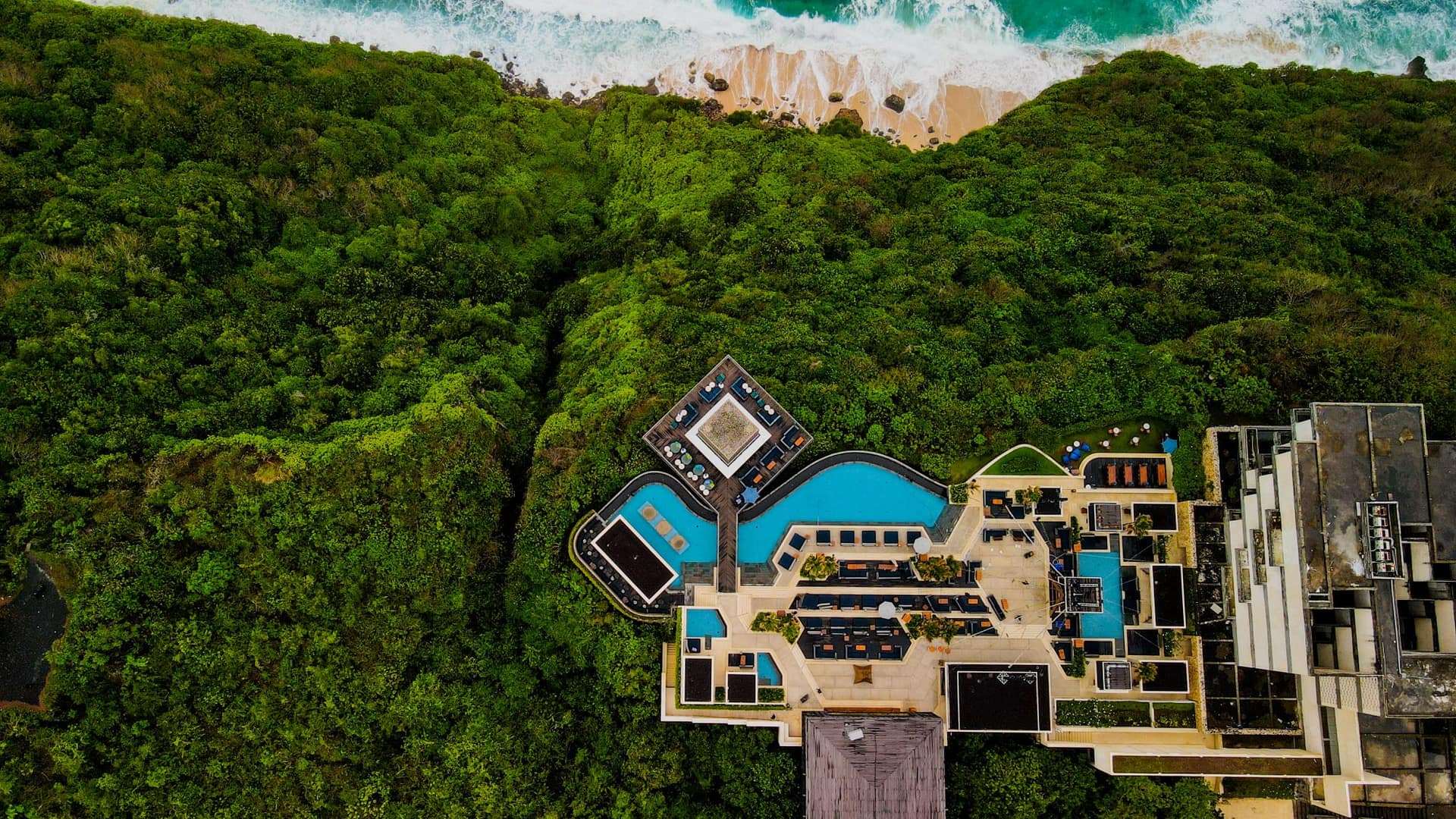
At the other end, Amanyara is one of the most restrained luxury properties in the region: 36 timber-shingled pavilions and 20 villas along the coast or overlooking ponds, an Asian-influenced indoor-outdoor aesthetic, black infinity pools, and a deliberate absence of programming. It is quiet in a way that some travelers find transcendent and others find expensive. Between those poles sit Grace Bay Club, Seven Stars, Wymara and The Somerset, all of which handle couples and small families comfortably.
The reef and the wall
The barrier reef around the Caicos islands is often cited as the third-largest on earth, and it does two things for visitors. Close in, it flattens the water along Grace Bay, which is why the swimming is so uniformly calm. Further out, at the Columbus Passage, it becomes a wall that drops thousands of feet — a genuine world-tier dive site, best between roughly Grace Bay's northwest sites and West Caicos.
For snorkelers, Smith's Reef and Bight Reef are shore-accessible from Grace Bay and unusually good for sites you can swim to. Between January and April, humpback whales pass through the Columbus Passage on migration, and Grand Turk and Salt Cay run the best encounters. Northwest Point Marine National Park, on Amanyara's doorstep, is protected and correspondingly rich. Our best luxury resorts for snorkeling and diving guide sets these sites against the Maldives and Bora Bora.
When to go
December through April is the prime window: warm, dry, low humidity and the calmest sea, with the highest rates over Christmas, New Year and the winter months. April and May are the standout value months — very nearly the same weather, fewer people, softer pricing and calm water that is ideal for snorkeling and boating.
Late August through early November is the cheapest stretch and the highest-risk, falling inside the June 1 to November 30 Atlantic hurricane season that peaks around September 10. Turks & Caicos is low-lying and Atlantic-exposed, so this is a window for flexible bookings and real insurance rather than a bargain to grab blind. The island is also drier than most of the Caribbean year-round, which is why even shoulder-season weather here tends to hold up better than the calendar suggests.
What it costs
Turks & Caicos is expensive, and it is worth being blunt about why: almost everything is imported, there is no income tax funding local production, and the island's low-rise planning rules cap supply against persistent demand. Restaurant prices routinely surprise first-time visitors, and a casual dinner for two with wine can clear $200 without effort.
Flights from the US East Coast run roughly three to three and a half hours, commonly $400–$800 round trip per person, with good direct service from Miami, New York, Charlotte, Atlanta, Boston and Toronto. Airport transfers are short — 15 to 25 minutes to most Grace Bay resorts. Luxury resort rates run roughly $700–$1,500+ per night for a room, with all-inclusive family properties quoted per person from around $450–$700 per night, and Amanyara and top villas well above both. Budget $250–$450 per couple per day for dining if you are not on an all-inclusive plan.
How it compares to the Bahamas
These two are the most common head-to-head in this part of the Atlantic and they split cleanly. The Bahamas wins on flight time — Nassau is barely an hour from Miami — on inter-island variety across 700 islands, and on boating days like the Exuma sandbar-and-swimming-pigs circuit. It also has more large-resort choice and more nightlife.
Turks & Caicos wins on the beach itself, on consistency, and on the reef. Grace Bay is a better single beach than anything in the Bahamas, the water is warmer in winter, and the diving is more serious. It is also smaller, quieter, and more expensive, with far less to do beyond the water. If you want one extraordinary beach and a reef, come here; if you want islands to explore and the shortest possible flight, the Bahamas. Our full Turks & Caicos vs Bahamas comparison works through it in detail.
Where to stay in Turks & Caicos
The resorts we have reviewed and scored in Turks & Caicos, ranked by our editorial score. Check live rates on any of them below.
Travelers who want silence more than they want programming
From $2,200/night · Our score 9.2/10
Families with children of any age
From $450 pp/night · Our score 8.8/10
Every “Check Rates” button opens live availability for that resort on Expedia. Rates as of September 2026. Always verify current pricing.
Frequently Asked Questions
- Grace Bay on Providenciales for the beach and the highest concentration of resorts and restaurants, with the eastern end generally offering the best water and sand conditions. Northwest Point, about 25 minutes away, is the choice for seclusion, design-led luxury and the marine reserve. Long Bay Beach suits villa groups and kitesurfers.